


At the New Jersey Warehouse & Movers Association’s 57th Annual Convention in September, REAG Vice President Rebecca Fatica joined Michael Lehman, CEO and Founder of Premier Path Wealth Partners, for “From Founder to Future,” a conversation about preparing to sell a business.
One moment stood out. Asked where buyers start, Rebecca began with EBITDA, then listed what gets added back: the country club membership, the company vehicle and, in one case she’s seen, deceased relatives still on the payroll. It got a laugh. It’s also where a lot of value is won or lost. Watch the full session.
What an add-back is
Buyers price your business on normalized EBITDA: what the company would earn under a new owner. You start with net income and add back interest, taxes, depreciation and amortization. Then you adjust expenses that run through the business but wouldn’t continue after a sale.
That second step is where owners get optimistic. Over years of running a company, personal and business spending blur together: the car, the phone plan, the family member on payroll, the dry cleaning. Each one feels like an obvious add-back to you. To a buyer, each one is a claim that has to be proven.
Why every add-back gets tested
Add-backs raise EBITDA, and EBITDA gets multiplied. At four times, every $100,000 in add-backs a buyer accepts is worth $400,000 in price. Every $100,000 they reject costs you the same.
So buyers validate them, and the timing works against you. As Rebecca explained, once a letter of intent is signed, the leverage shifts to the buyer because you’re exclusive. Buyers use diligence to confirm earnings, evaluate risk, and test the assumptions behind their offer. Findings may give a buyer reasons to renegotiate. An add-back that falls apart at that stage doesn’t just shrink EBITDA. It can also make the buyer question other adjustments you’ve presented.
What holds up and what doesn’t
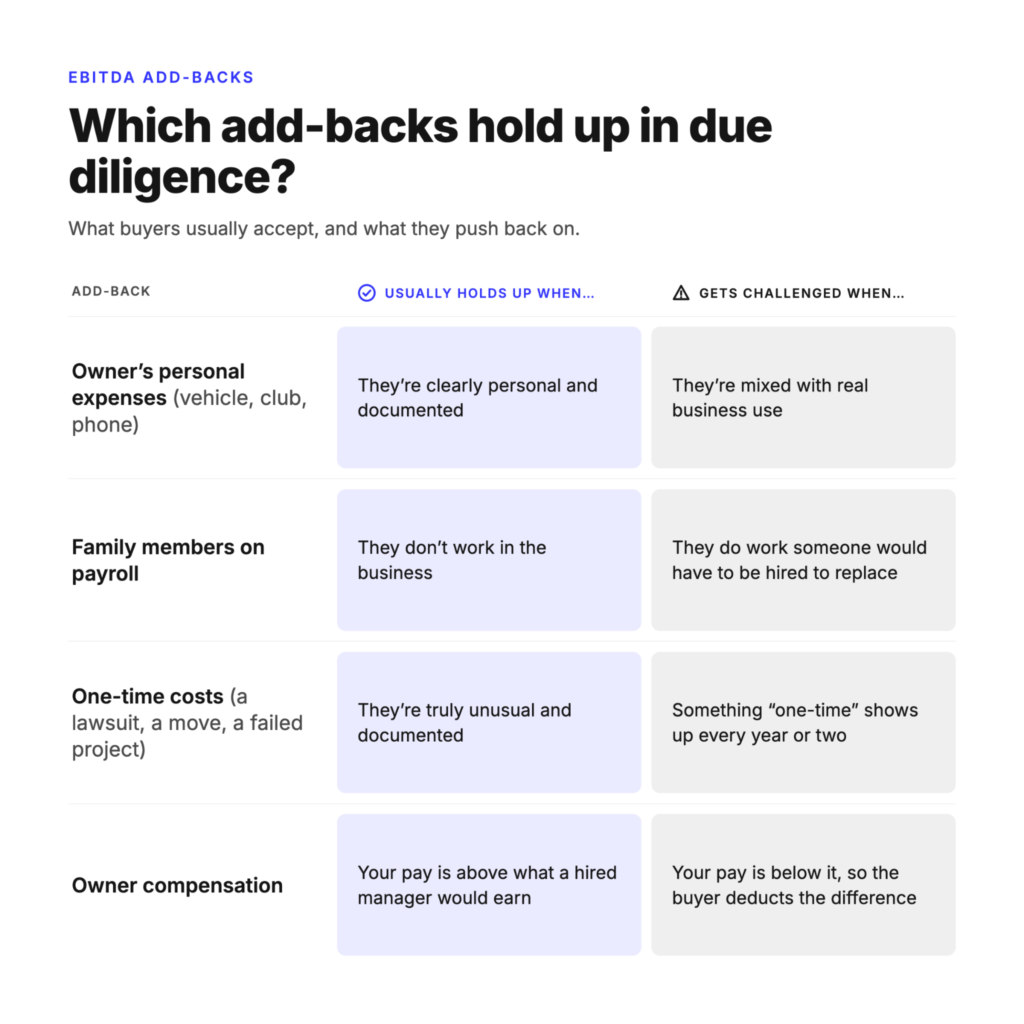
The last row surprises owners most. Normalizing cuts both ways. If you’ve paid yourself a small salary and taken profit as distributions, a buyer will subtract the cost of the manager who replaces you.
Test your number before a buyer does
A quality of earnings (QoE) report is an independent review of your earnings by an accounting firm. Buyers commonly commission one during diligence. Michael’s advice at NJWMA was to get your own first, early in the process.
A sell-side QoE identifies weak add-backs while you still have time to support them, correct the underlying issue or remove them from your normalized EBITDA. You go to market with a number that has already been tested. Your advisor can then negotiate from firmer ground when the buyer’s accountants start asking questions.
What to do at this year-end close
Buyers typically review at least three years of financials. For an owner who might sell in 2028 or 2029, the books you close this December are already part of that record.
- Stop running personal expenses through the business, or document every one you keep.
- Ask your CPA to list this year’s add-backs, with support for each.
- Flag one-time costs now, while the paperwork is fresh.
- Compare your own pay with what a hired manager in your role would earn.
- Direct capex and spending toward what makes the business more valuable, not just toward a lower tax bill.
- If a sale is two or three years out, ask about a sell-side QoE.
Next step
Clean add-backs won’t make your business more valuable on their own. But they protect the value you’ve built, and they show a buyer you have nothing to hide.
If a sale is anywhere on your horizon, REAG’s Transaction Readiness Advisory helps you test your numbers before a buyer does. Start a confidential conversation.