


If you own a manufacturing, chemicals, specialty plastics, logistics, or electronics business, you’ve likely heard two conflicting pieces of advice: sell now before tariffs make your business harder to value, or wait for interest rates to fall so buyers can pay more.
The short answer: for most owners, preparation matters more than timing. Well-run lower middle market businesses are still drawing competitive bids. EBITDA multiples for companies valued at $5M–$50M reached 5.8x in Q2 2026, the highest since early 2022, according to the IBBA and M&A Source Market Pulse Survey. But if tariffs have compressed your trailing EBITDA, buyers will start from that lower number unless you can show what normalized earnings look like.
How Are Tariffs Affecting Business Valuations?
For most lower middle market companies, the main effect of the 2025–2026 tariffs isn’t lost demand. It’s margin compression. When imported inputs cost more, EBITDA falls, and EBITDA is the number buyers underwrite.
The impact varies by sector:
- Manufacturing and fabrication: Section 232 tariffs on steel and aluminum raise material costs directly. Shops with fixed-price contracts are hit first.
- Chemicals and Specialty Plastics: Costs for feedstocks, resins, and additives are higher and less predictable, which makes margins harder for buyers to model.
- Logistics and Transportation: The effect shows up more in volume and lane mix than in input costs.
- EMS and PCBA: Tariff exposure sits deep in the bill of materials, so buyers will ask how much of it is contractually passed through to customers.
Can owners add back tariff costs when selling their business?
Usually not. Buyers accept adjustments for one-time costs, and tariffs may persist. What moves a buyer is evidence that your business has adapted:
- Price increases your customers have accepted
- Contracts that pass input costs through to customers
- Diversified or domestic sourcing
- Monthly financials that separate tariff impact from underlying performance
An owner who can say “margins dipped for two quarters, here’s what we did, and here’s the run rate since” is in a much stronger position than one asking a buyer to ignore a bad year.
How Do Interest Rates Affect What Buyers Will Pay?
Higher rates send more of a company’s cash flow to interest, so buyers pay less at entry to hit the same returns. Illustrative example: for every $10 million of acquisition debt, a one-point move from 8% to 9% adds $100,000 in annual interest expense. Buyers recover that through price, structure, or both.
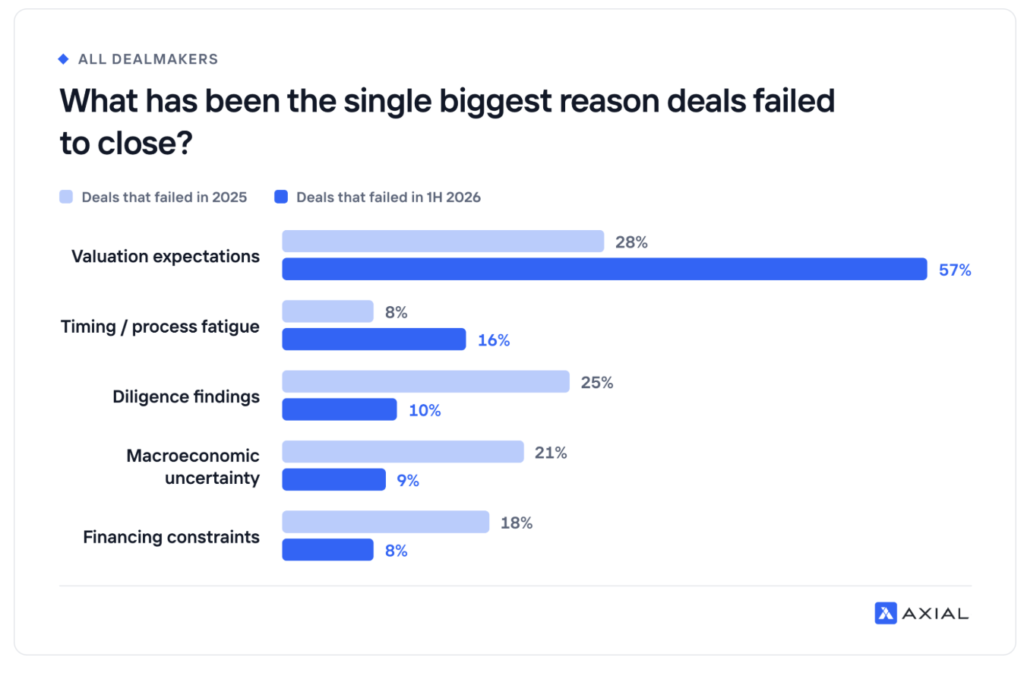
But rates are no longer the main obstacle. In Axial’s mid-2026 survey of lower middle market dealmakers, financing constraints fell from 18% to 8% as the cited reason deals failed. Unrealistic valuation expectations rose from 28% to 57%. Sellers going to market with 2021-era expectations are the ones getting stuck.
Waiting for rates to fall is a bet. Cheaper debt would help buyers pay more, but no one can reliably predict when it will come, your own results could change in the meantime, and more sellers tend to come to market once conditions improve. The owners who do best aren’t the ones who guessed right on timing. They’re the ones who were ready when they decided to move.
Are Buyers Still Active in Industrial M&A?
Yes, but they’re more selective. In the IBBA and M&A Source survey, 87% of deals in the $5M–$50M range drew at least three offers.And, according to Axial’s survey, 73% of buyers expect to meet their 2026 acquisition targets, yet 53% say closing deals has gotten harder, and 40% cite a shortage of quality companies as a top constraint.
Buyers have capital, and too few businesses they want to buy.That’s good news for prepared sellers.
Diligence now focuses on anything that makes future earnings less predictable:
- Customer concentration: Any single customer above 15–20% of revenue
- Key-person dependency: Sales, operations, or relationships that rely on the owner
- Input cost exposure: Costs vulnerable to tariffs or commodity swings
- Management depth: Whether a team can run the business without you
- Quality of earnings: Whether your financials hold up to a third-party review
Businesses that hold up attract competitive bids. Those that don’t face lower valuations, heavier earnouts, or buyers who walk away. As we wrote recently in “The Silver Tsunami Is Real. The Warning Business Owners Are Getting Is Wrong,” capital isn’t the constraint in this market. Quality is.
Why Deal Structure Matters More Than the Headline Price
When buyers are less certain about future earnings, they shift risk to the seller. SRS Acquiom’s 2026 lower middle market report, covering more than 4,400 transactions, found earnouts in 29% of deals up to $50 million and 35% of deals up to $25 million.
Consider a hypothetical $20M sale. By the time the purchase agreement is signed, $4M might be tied to an earnout paid over two years, $2M to a seller note the buyer repays over time, and another $2M held in escrow for 12 to 18 months. That leaves about $12M paid at closing, before taxes, debt payoff, and fees. The remaining $8M depends on how the business performs, whether the buyer pays the note, and whether any claims arise after closing.
None of that is unusual, and all of it is negotiable, but only if you understand earnout metrics, seller note terms, rollover valuation, and the working capital peg before you’re at the table.
How REAG Helps Owners Prepare
Before we talk about timing, we look at what a buyer sees when they look at your business today.We work through your tariff exposure, normalized earnings, the non-financial factors that move multiples, and the deal structure you’re likely to face, well before you go to market.
If you’re 18 to 36 months from an exit, start preparing now. Whatever rates do, it’s important to understand what an exit really looks like. Preparation moves the price. It also moves how much of that price is cash at closing rather than contingent on what happens after.
REAG focuses on manufacturing and fabrication, chemicals, specialty plastics, logistics and transportation, and EMS/PCBA companies with up to $250M in revenue and $25M in EBITDA. We’ve closed more than 100 transactions across 25+ industries over 20+ years.
Whether you’re ready now or three years out, start with a confidential strategy session.
📞 833-333-REAG (7324) | ✉️ info@reag.com | 🌐 reag.com


